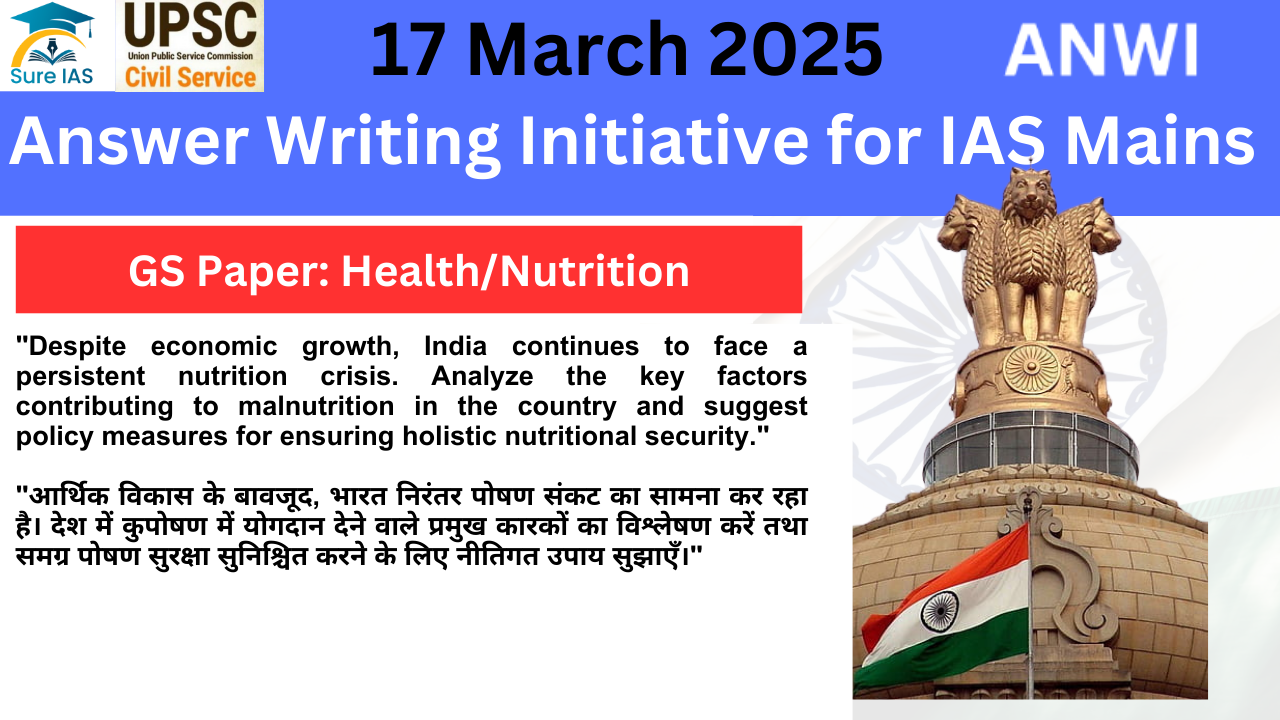
“The right to protest is a cornerstone of a democratic society, yet it often faces legal and political challenges in India. Examine the constitutional basis of the right to protest, its limitations, and the evolving jurisprudence. Suggest measures to balance public order with citizens’ right to dissent.”
Content for Answer Writing:
Introduction
The right to protest is intrinsic to a functioning democracy as it allows citizens to express dissent and hold the state accountable.
In India, though not explicitly mentioned, it stems from the broader guarantees of Fundamental Rights under the Constitution.
However, rising tensions between state authority and civil liberties often bring this right into legal and political crossfire.
I. Constitutional Basis of the Right to Protest
Article 19(1)(a) – Freedom of speech and expression.
Article 19(1)(b) – Right to assemble peaceably and without arms.
Article 19(1)(c) – Right to form associations or unions.
Article 21 – Right to life and personal liberty, interpreted to include dignity and autonomy.
Case Law:
Ramlila Maidan Incident v. Union of India (2012) – SC emphasized that the right to peaceful protest is part of democratic ethos.
Maneka Gandhi v. Union of India (1978) – Expanded the scope of Article 21 to include procedural fairness and freedom of movement.
II. Legal and Practical Limitations
Reasonable Restrictions under Article 19(2) & (3)
Restrictions can be imposed in the interest of sovereignty, security, public order, decency, or morality.
Unlawful Activities Prevention Act (UAPA)
Often invoked to preempt protests, sometimes curbing lawful dissent.
Use of Sedition (Section 152 Bharatiya Nyaya Sanhita (BNS))
Misused in cases like the arrest of student activists, though SC in Kedar Nath Singh (1962) clarified that mere criticism is not sedition.
Infrastructural limitations
Cities often lack designated protest spaces or restrict them to remote locations, defeating the purpose of visibility.
III. Evolving Jurisprudence on Protest Rights
Shaheen Bagh Judgment (Amit Sahni v. Commissioner of Police, 2020)
SC held that protests should not inconvenience the public, restricting indefinite occupation of public places.
Mazdoor Kisan Shakti Sangathan v. Union of India (2018)
Affirmed the right to protest at Jantar Mantar, acknowledging the need for a designated democratic space.
Farmers’ Protests & CAA Protests
Sparked debates on balancing civil liberties with security concerns, showing the need for institutional clarity.
IV. Measures to Balance Public Order and Right to Dissent
Codify Protest Guidelines
Uniform national framework ensuring time-bound, location-flexible protests without arbitrary denial.
Designated Protest Zones
Easily accessible, visible public spaces across cities for democratic gatherings.
Judicial Oversight
Fast-track courts to address protest-related curbs, misuse of sedition/UAPA laws.
Police Reform and Training
Sensitize law enforcement to handle protests humanely and constitutionally.
Digital Platforms for Expression
Promote online petitions, video protests, etc., in tandem with physical protests.
Conclusion
The right to protest reflects the voice of democracy and must be preserved with constitutional sensitivity.
Ensuring a delicate balance between order and liberty, through legal safeguards and empathetic governance, is essential for a vibrant, participative India.